Happy Hands
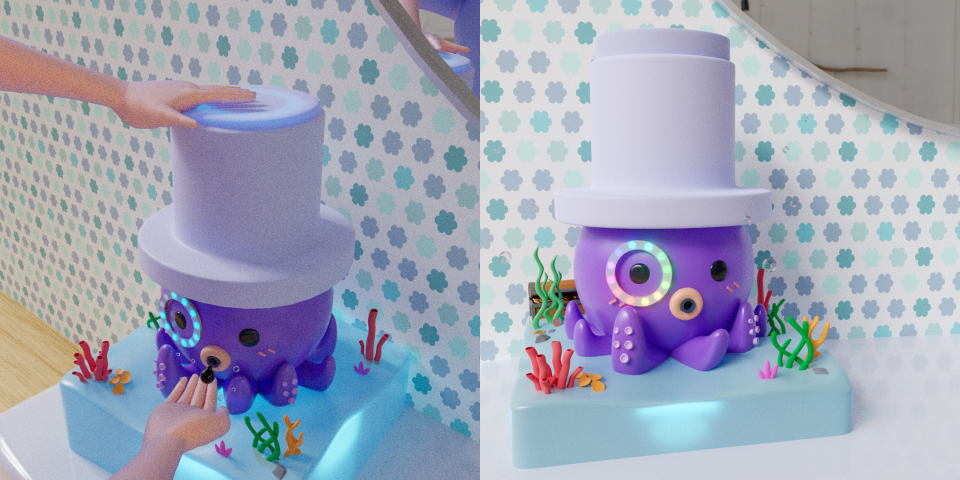
Inky the Octopus is an interactive soap dispenser whose magic “ink” and playful audio cues inspire healthy handwashing habits in children ages 7-10.
overviewIn four weeks, my team and I created three prototypes using two methods (wizard-of-oz prototyping and physical prototyping) and conducting tests in between, in an iterative design process.
roleDesigner and researcher
TeamThree other graduate students
companyMHCI+D at University of Washington
duration4 weeks
Proper hand washing is the first line of defense
against the spread of many illnesses: from the common cold to more serious infections, such as meningitis, bronchiolitis, the flu, hepatitis A, and many types of diarrhea. However, according to a study published by the American Cleaning Institute, 43% of children are not washing their hands well or enough.
What is proper hand washing?
The Center for Disease Control and Prevention, or CDC, recommends a 5-step process for healthy and effective hand-washing:
Wet hands
Get soap
Scrub for at least 20 seconds
Rinse hands
Dry
“Hand washing with soap could protect about 1 out of every 3 young children who get sick with diarrhea and almost 1 out of 5 young children with respiratory infections like pneumonia.”
- Center for Disease Control and Prevention, 2019
We tested 3 prototypes to iterate and improve on the idea of an interactive soap dispenser that could keep children washing their hands for the full 20 seconds.
Prototype #1: A machine that will destroy… bad handwashing habits?
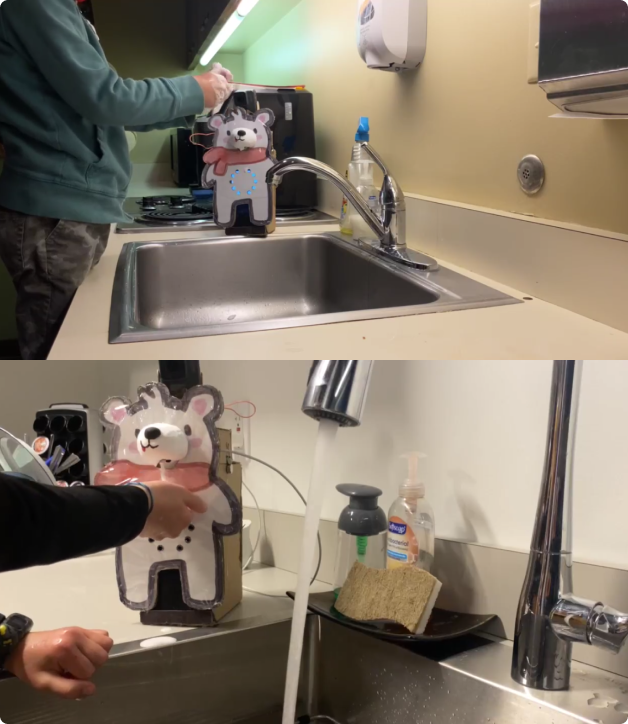
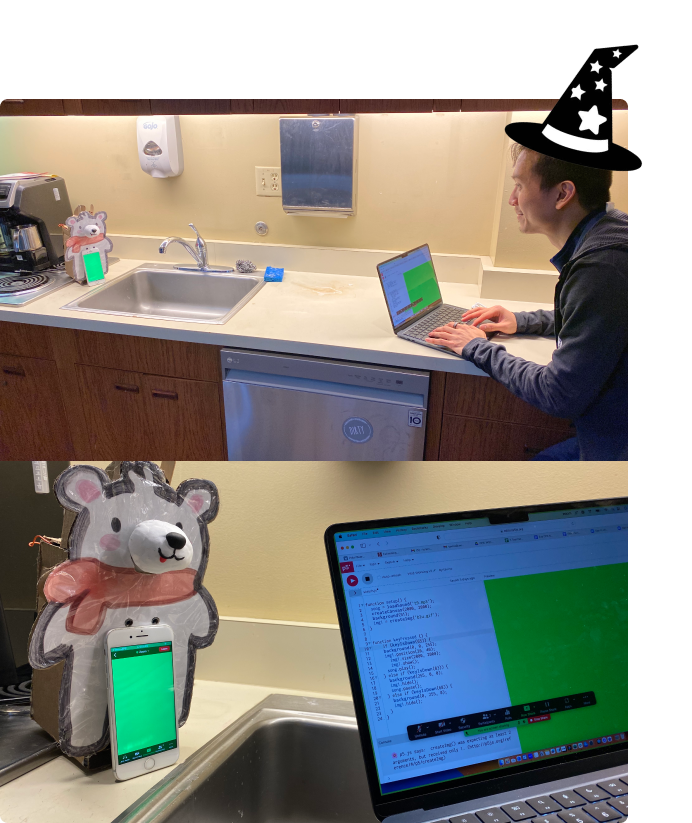
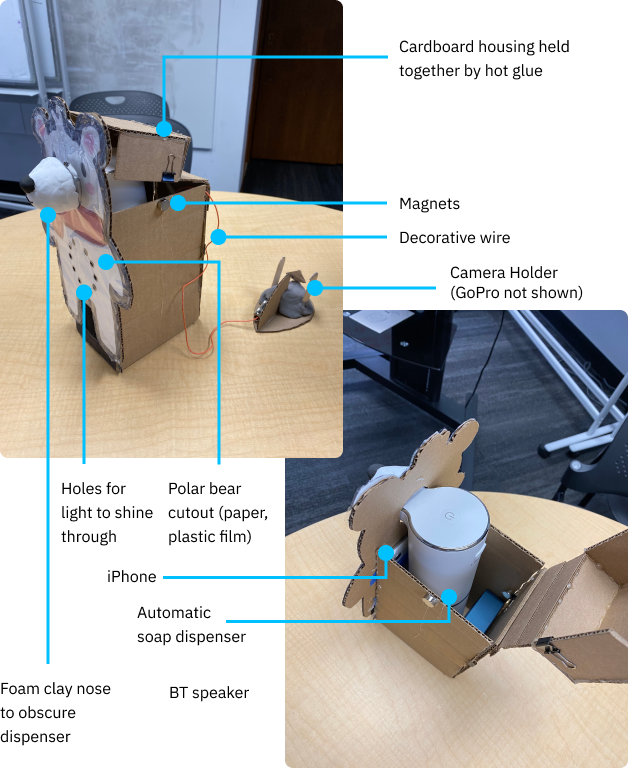
We created a wizard-of-oz prototype for a soap dispenser with machine vision and tested with 4 children ages 5-8 and 2 parents
When soap is dispensed, music and lights (controlled by the wizard) are initiated and last for 20 seconds. If handwashing stops, machine vision will detect it and stop playing the lights and music.
We tested versions with “machine vision” and without in order to determine the role machine vision would play when children go to wash their hands and if it could effectively teach them to wash for the full 20 seconds.
Behind the wizardry
We rapidly prototyped by using affordable, ready-made and common materials
Results from WOZ testing
1/
2/
3/
4/
We ruled out machine vision as a way to motivate children to wash their hands — participants felt awkward so we needed to find a more encouraging method.
“It would be embarrassing if [people saw me stop washing my hands] on the news.”
Tests validated the use of music and Happy Hands’ potential to help teach many children, such as in a classroom setting.
Target user group should be elementary school age: tests were understandable for our 7- and 8-year-old participants, but the 5-year-olds stopped washing both times.
Tests validated using a 20-second timer.
“I really liked it... No one knows how long 20 seconds is.”
Prototype #2: Machine vision out. Time-awareness in.
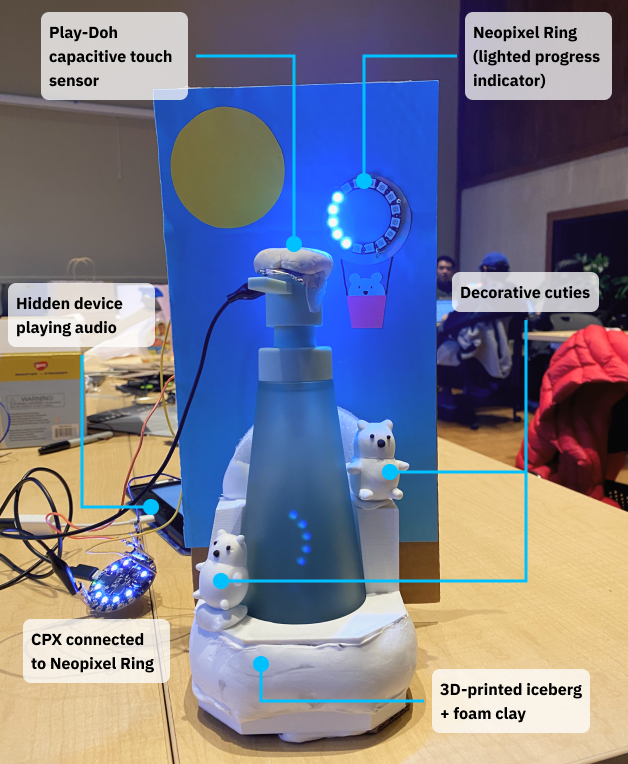
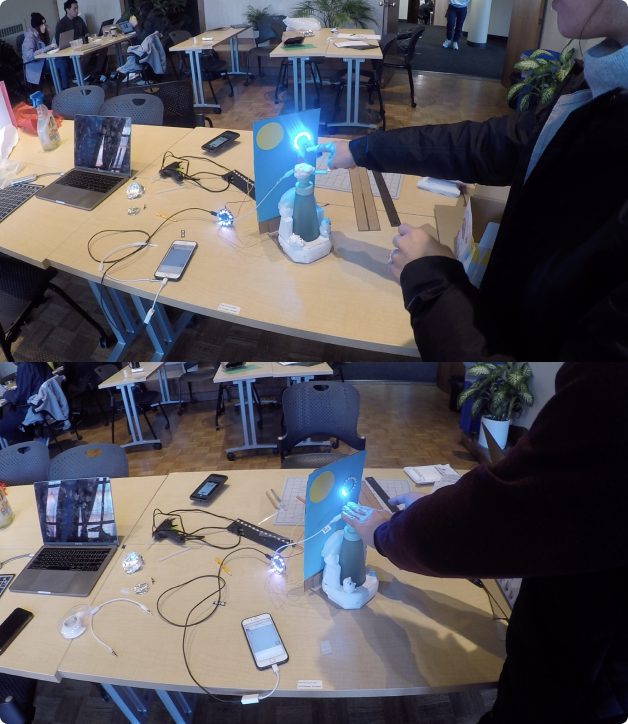
Our second prototype was fully interactive, and we hypothesized that emphasizing the length of time (20 seconds) in a fun way might just be enough.
Since machine vision didn’t work, we pivoted and tried to address “time blindness” in young children by emphasizing how long 20 seconds is through just lights and music in a playful theme.
The lights on the Neopixel ring progressively light up while music plays for 20 seconds. Finally, a celebratory audio sound at the end to congratulate washers on a job well done.
We rapidly tested with two adult participants in our design studio.
Testing validated:
The “cute” aesthetic
The clear purpose of the lighted progress wheel
Problems to fix:
The delay between pressing down on the pump and timer start
The pump needed to be easier to press down on
We were on track with this approach, and now just needed to iron out the bugs and test with children.
Prototype #3: Inky, the friendly-but-stately “bioluminescent” squid who encourages proper handwashing
We created a playful mascot to appeal to children, and developed research-backed specific audio cues.
Audio cueing was working in our tests, so we leaned more fully into that. We also wanted to amp up the playfulness to appeal to kids even more.
Our response to children’s need for play has been through the character design of Inky, complete with a gentlemanly voice, top hat that pushes down, and black “ink” soap. Against a background of music, Inky encourages washers to “keep scrubbing!” until they’re “all done!”
We based the specific language of these audio cues on research stating that informational-based praise produces healthier performance-improvement outcomes than ability-based.
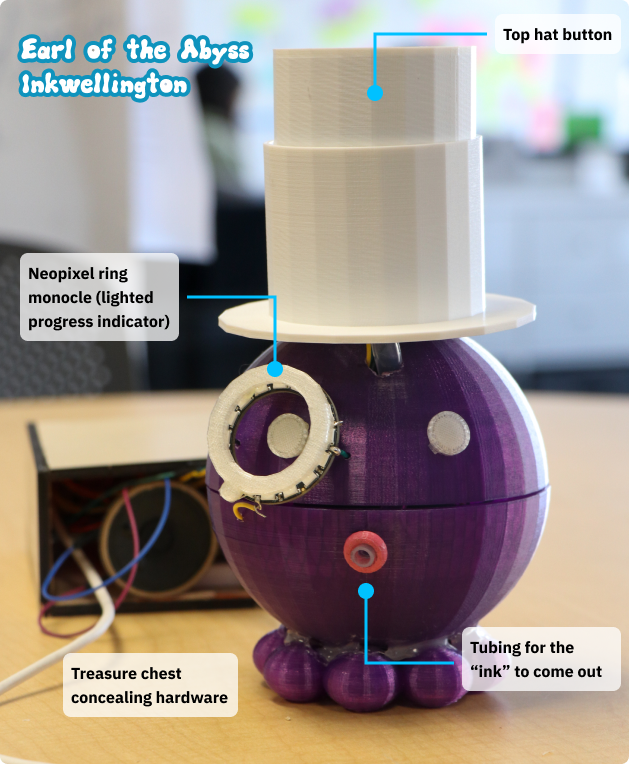
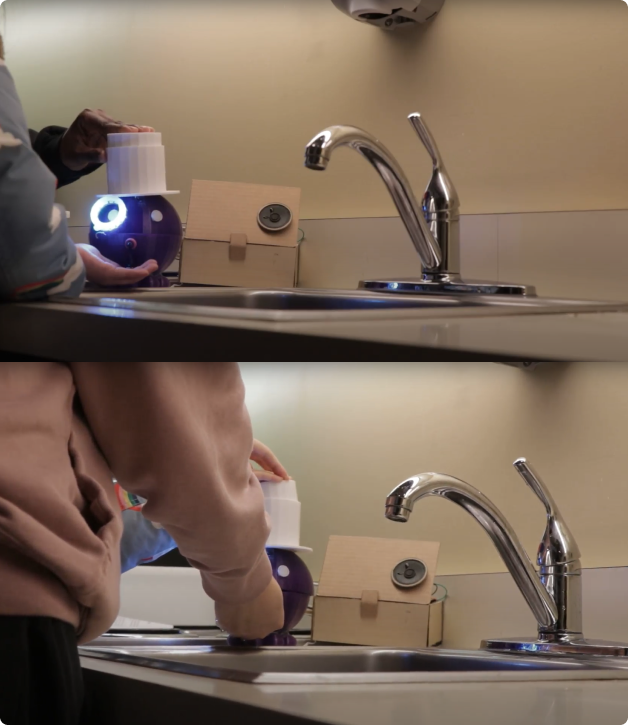
We tested with 4 adults and one 5-year old, including countless more child participants at the design showcase.
The audio cues were such a hit that one participant requested even more congratulations after the time was up, just to enjoy their success.
We found that while it worked for the child, ironically, adults washed and rinsed in the 20 seconds, demonstrating improper hygiene and suggesting that a tool for adults might need more instruction at the beginning, such as an audio cue telling them to scrub until time’s up.